
Gym vs home workout comparisons usually focus on things like equipment, workout quality, or calorie burn. But if you are like most people, that is probably not the question you are really trying to answer.
What you may actually want to know is much simpler: Which routine will you still be following three months from now?
A gym might give you more equipment, structure, and accountability. A home workout might save time and fit more easily into a busy schedule. Both can work. The challenge is figuring out which one fits your life well enough to become a routine instead of another fitness plan that gets abandoned after a few weeks.
In this gym vs home workout guide, we will compare both options across results, cost, convenience, flexibility, and long-term sustainability so you can choose the one that realistically fits your lifestyle.
- Quick Gym vs Home Workout Comparison Table
- Why Busy Schedules Break Most Workout Plans
- Where Gym Workouts Have a Real Advantage
- Where Home Workouts Work Better for Busy People
- Can You Get the Same Results at Home?
- How a Trainer Changes the Gym vs Home Workout Decision
- Gym vs Home Workout Cost: What People Underestimate
- Which Option Fits Your Lifestyle Best?
- Final Thoughts
- Sources
- FAQ
Quick Gym vs Home Workout Comparison Table
If you want the short version first, this table shows the biggest gym vs home workout differences before we get into the details.
| Factor | Gym Workouts | Home Workouts |
| Commute | Requires travel | No commute required |
| Cost | Membership and possible travel costs | Low startup cost, but equipment may add up |
| Equipment | Wider range of weights and machines | Limited to what you own or can store |
| Training Space | Dedicated workout environment | Uses your available living space |
| Access | Limited by location and opening hours | Available whenever your space is free |
| Strength Progression | Easier to increase resistance gradually | May become limited by available equipment |
The table gives a quick overview, but the better choice is rarely about which option looks best on paper. It is about which one still works when life gets busy.

Why Busy Schedules Break Most Workout Plans
Most people do not quit exercising because they suddenly stop caring about their health. More often, life simply gets in the way.
You might start with a plan that feels realistic. Then work becomes stressful, your schedule changes, family responsibilities pile up, or your energy drops after a long day. Suddenly, a routine that looked manageable on Sunday starts feeling much harder to follow by Wednesday.
One of the biggest mistakes people make is building workout plans around ideal weeks instead of real ones. Many routines quietly depend on:
- Having plenty of free time
- Feeling motivated every day
- Uninterrupted evenings
- Long workout sessions every week
The problem is that most weeks do not look like that. After a full day of work and responsibilities, even small tasks can start feeling like extra effort. Research on inactive adults shows the same problem: time, energy, and planning often make workouts harder to keep up.
That is why the gym vs home workout decision should start with your real week, not your ideal one. The better option is usually the one with fewer barriers on the days when your schedule is messy, your energy is lower, and your motivation is not doing you any favours.

Where Gym Workouts Have a Real Advantage
Home workouts solve a lot of practical challenges, but they are not the right answer for everyone. Depending on your personality, goals, and training experience, a gym may offer advantages that are difficult to recreate at home.
If you have ever struggled to stay focused, push yourself during workouts, or make consistent strength progress, some of those advantages may matter more than you think.
Better Training Focus
If you have ever tried to work out at home while thinking about work, chores, emails, or everything else waiting for you, you already know how easy it is to lose focus.
A gym creates a clearer separation between exercise and the rest of your day. In a dedicated training environment, it may be easier to:
- Follow your workout plan without switching between exercise and other tasks
- Complete the session with fewer interruptions from messages, chores, or people around you
Not everyone needs that separation. Some people can focus well at home, especially when they have a designated workout space. But if distractions regularly interrupt your home workouts, a gym may give you the separation you need to follow through.
Easier Strength Progression
As you get stronger, your workouts need to become more challenging. This gradual increase in training demand is known as progressive overload, a key part of building strength and muscle.
A gym can make progressive overload easier by offering:
- A wider range of weights and resistance machines
- Smaller increases in resistance as you get stronger
You can also progress at home with adjustable weights or harder bodyweight variations. However, as you become more advanced, the resistance available at home may eventually limit your progress.
Built-In Accountability
Not everyone needs external accountability to stay consistent. Some people train consistently on their own, while others follow through more reliably when a workout has a set time and structure.
A gym can provide that structure when you:
- Treat the gym visit as a fixed appointment in your schedule
- Book a class or personal training session
- Meet a workout partner who expects you to show up
These commitments make it harder to keep postponing the workout. They also remove one more decision from an already busy day. The gym itself does not create accountability automatically. But if self-scheduled workouts regularly fall through, a gym class, trainer, or workout partner may give you the structure you need.
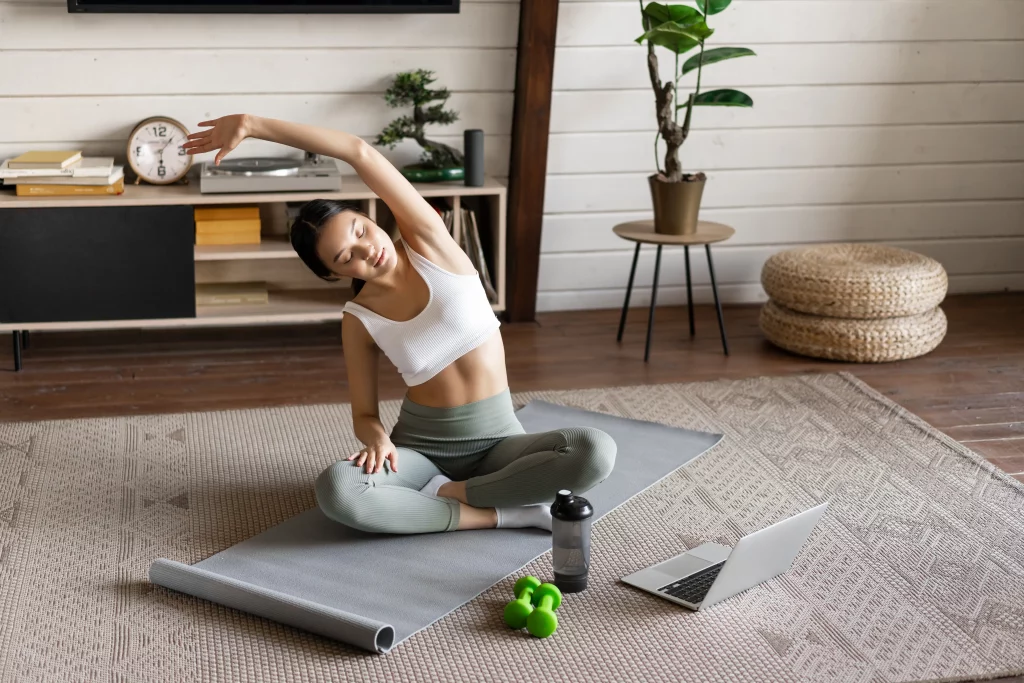
Where Home Workouts Work Better for Busy People
Gym workouts offer structure and equipment advantages, but home workouts solve a different problem entirely: startup friction.
Lower Startup Friction
One Reddit discussion about home training captured something many people recognize: working out at home is not always easier than going to the gym. One of the biggest advantages of home workouts is that they reduce the gap between wanting to exercise and actually starting.
A gym workout may last only an hour, but preparation, travel, and scheduling can make the full commitment much longer. At home, you do not have to:
- Pack a gym bag
- Commute or find parking
- Wait for equipment during busy periods
- Plan around gym hours
On a busy day, the extra steps required to start can be enough to make you postpone the workout until you no longer have the time or energy for it. Lower startup friction does not mean home training is the better environment for everyone.
Some people find it easier to exercise consistently in a dedicated gym environment. But if those extra steps regularly cause you to skip workouts, exercising at home may be the more practical option.
More Adaptable to Unpredictable Schedules
One advantage of home workouts is that they give you more room to adjust the workout instead of skipping it. If something unexpected comes up, you can move the workout, shorten it, or switch to a simpler session without skipping it completely. That flexibility allows the workout to fit the day instead of forcing the day to fit the workout.
Common Home Workout Limitations
Home workouts are convenient, but your available space and setup can still create practical challenges. Depending on your space, equipment, and living situation, you may have to deal with:
- Limited room for exercises that require more floor space or movement
- Noise concerns from jumping, high-impact movements, or setting down weights
- Having to clear space before each workout
- A lack of room to store larger equipment
These limitations do not make home workouts ineffective. They simply mean that some types of training are harder to manage at home, especially when space, noise, or equipment are limited.
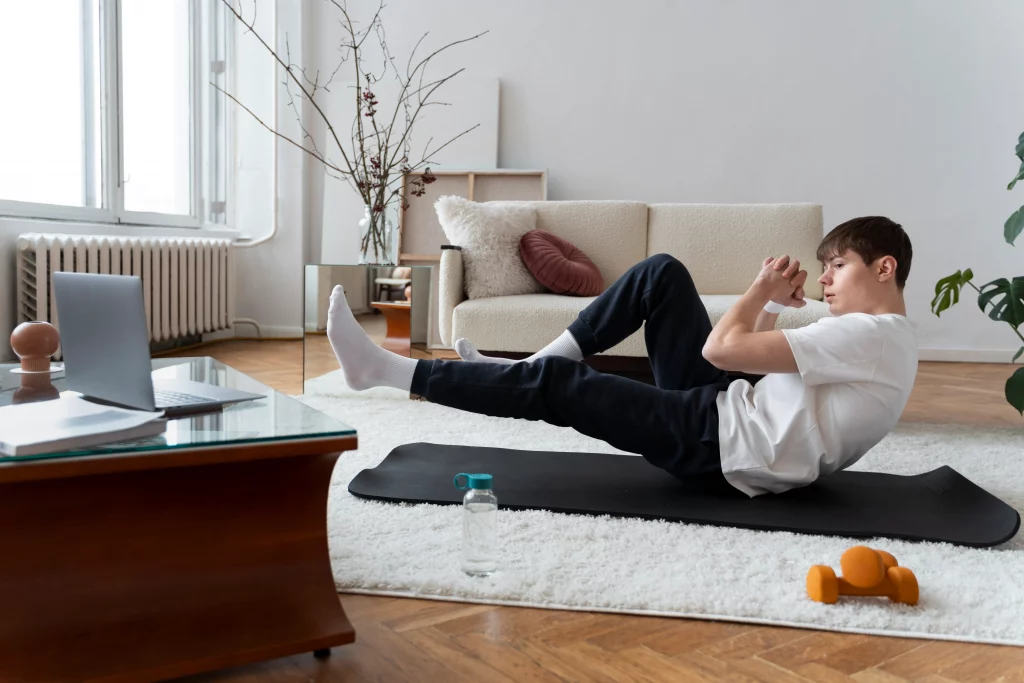
Can You Get the Same Results at Home?
If you are wondering whether working out at home can deliver similar results, the short answer is often yes.
Fat Loss:
- Where you work out is usually less important than nutrition and overall activity.
- Home or gym workouts can both be effective.
Strength:
- Home workouts can take you a long way.
- Many beginners make progress with bodyweight exercises, resistance bands, or a simple set of dumbbells.
- Home workouts remain highly effective for developing strength.
Muscle Growth:
- Differences become more noticeable at advanced goals.
- Home workouts still produce results.
- Gyms may offer more opportunities as training goals become increasingly demanding.
Home workouts can still work well, especially when your plan matches your goals, equipment, and schedule. But the plan itself often matters more than where you train. That is one reason a trainer can have a bigger impact on your results than many people realize.
How a Trainer Changes the Gym vs Home Workout Decision
Sometimes, the hardest part is not choosing between a gym workout and a home workout. It is knowing how to make either option work for your body, schedule, and goals.
That is where a fitness trainer can help. Instead of guessing which exercises to do, how hard to push, or how to adjust your plan, you get structure that fits the place you actually train.
| Where You Train | What a Trainer Helps With Most |
| Gym | Using equipment correctly, improving form, building strength, and following a clear plan |
| Home | Choosing the right exercises for your space, adjusting workouts, and making progress with limited equipment |
How an In-Person Trainer Helps at the Gym
If you prefer training at the gym, an in-person trainer can help you feel more confident around machines, weights, and unfamiliar exercises.
This can be especially useful if you want to lift heavier, avoid random workouts, or make steady progress without feeling unsure about what to do next. A trainer can also help you use equipment more intentionally, so your gym sessions feel less confusing and more focused.
You can usually find an in-person trainer in a few ways:
- Ask about personal training options at gyms near you
- Use Google Maps to search for personal trainers in your area
- Check trainer reviews, credentials, and specialties before booking
- Ask whether the trainer works at a gym, studio, park, or private space
In the U.S., hourly rates for in-person trainers usually range from $40 – $100 in gyms, $100 – $175+ for private or off-site sessions. Rates can be higher in large cities or with more experienced or specialized trainers.
How an Online Trainer Helps With Home Workouts
If home workouts fit your schedule better, an online personal trainer can help you train with more structure without leaving your space.
This can be helpful if you want to:
- Follow a personalized workout plan instead of random videos
- Choose exercises that match your goal and fitness level
- Use bodyweight exercises, resistance bands, dumbbells, or a small space more effectively
- Get real-time guidance through live video sessions
- Stay accountable and adjust workouts when your schedule changes
At Happy Trainers, we make this easier because you can compare online personal trainers, review their specialities, and choose someone who fits your goals, budget, and routine. Online sessions start at just US$4 per hour, with rates varying by coach, experience, and session format. This makes coaching accessible while helping you structure home workouts effectively.
This can make online coaching a practical option if you want support and accountability but still need your workouts to fit around a busy schedule.
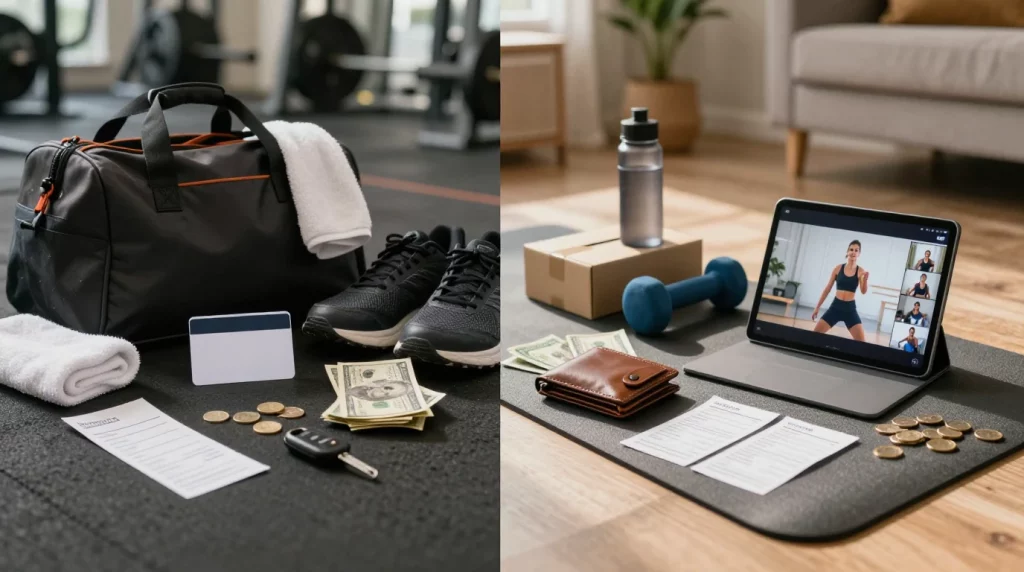
Gym vs Home Workout Cost: What People Underestimate
Cost is one of the biggest differences in the gym vs home workout decision, but it is easy to compare the wrong numbers.
Gym Cost Depends on Use, Not Just Membership
A gym membership may look affordable at first. In the U.S., many memberships fall somewhere around $10 to $100 per month, depending on the gym, location, and what is included.
But the real value depends on how often you go. If you pay $60 per month and go 12 times, each workout costs about $5 before extra fees. If you only go twice, each workout effectively costs about $30.
Home Workout Costs Are More Adjustable
Home workouts can start with little or no equipment, especially if you use bodyweight exercises. Later, you might add a mat, resistance bands, dumbbells, an app, or coaching support.
So home workouts are not always free, but the cost is usually easier to control. You can start small, add only what you need, and avoid paying for a setup you do not use.
Here is where the real cost comparison becomes clearer:
| Cost Factor | Gym Workouts | Home Workouts |
| Typical starting cost | Often a monthly membership. Many U.S. gym memberships cost around $10 to $100 per month. | Can start very low if you use bodyweight exercises. |
| Extra fees | May include initiation fees, annual fees, classes, cancellation rules, locker fees, or personal training. | May include a mat, resistance bands, dumbbells, fitness apps, or coaching. |
| Transportation cost | Gas, parking, or public transit can increase the real monthly cost. | Usually none. |
| Trainer package costs | In-person packages may lower the per-session rate, but many still cost around $40–$100+ per session. | Online packages are often more flexible, with Happy Trainers options starting around $4/hour. |
| Value risk | Paying for a membership you do not use often enough. | Buying equipment, apps, or programs you do not stick with. |
| Best budget fit | You use the gym consistently enough to justify the full monthly cost. | You prefer a simple setup and can train regularly at home. |
The cheaper option is not always the better deal. A gym can be worth the price if you use it often and the environment helps you stay consistent. A home setup can be worth it if it removes extra costs and makes workouts easier to repeat. The best budget choice is not just the one with the lowest price. It is the one you are most likely to keep using.
Which Option Fits Your Lifestyle Best?
By now, you have probably realized that there is no clear winner in the gym vs home workout debate. What works best often depends on your schedule, goals, and the obstacles that make it harder for you to stay consistent.
| Situation | Better Fit | Why |
| Very limited free time | Home workouts | Easier to fit into busy days |
| Need accountability | Gym workouts | More external structure |
| Get distracted easily at home | Gym workouts | Dedicated training environment |
| Advanced muscle-building goals | Gym workouts | Easier long-term progression |
| The schedule changes constantly | Home workouts | Easier to adapt to unexpected changes |
| Gym anxiety | Home workouts | A more private environment |
| Struggle to stay focused | Gym workouts | Fewer competing distractions |
| Prefer convenience | Home workouts | Fewer barriers to getting started |
If you find yourself matching both sides of the table, that is completely normal. Many people combine home workouts and gym training depending on their schedule, goals, and preferences. Some people also add coaching support to make that approach easier to follow. If you are considering that option, this online personal trainer cost breakdown explains common pricing models and what influences pricing.
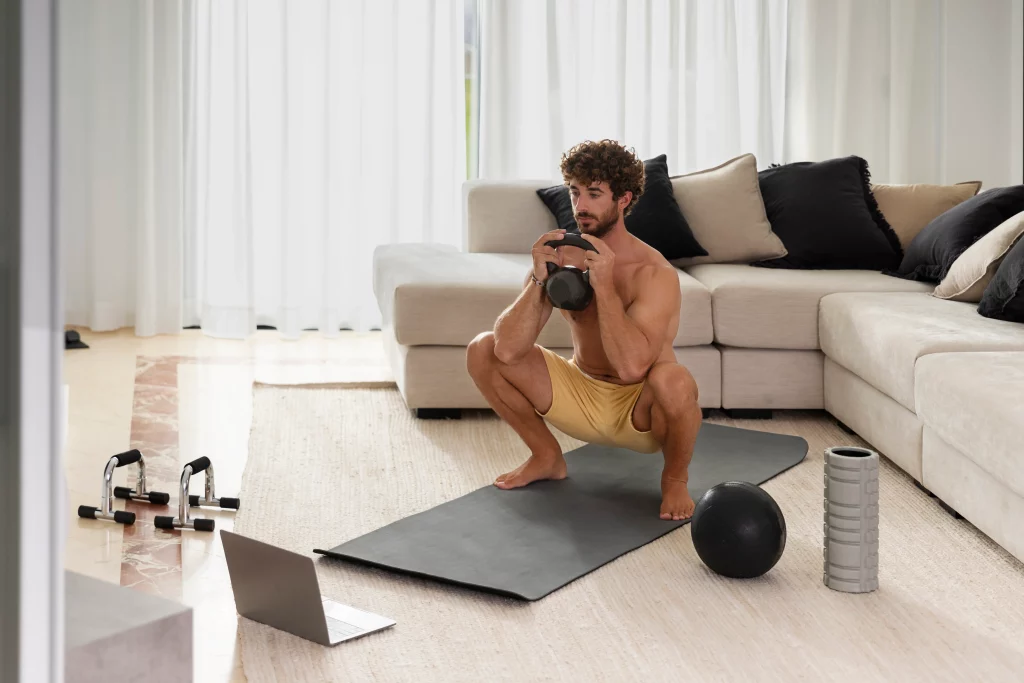
Final Thoughts
If you came here looking for one clear winner, the honest answer is this: it depends.
Both gym workouts and home workouts can work well. The better choice is the one that removes your biggest barrier right now. If getting started feels hardest, home workouts may make exercise easier to begin. If focus, equipment, or accountability matter more, the gym may be the better fit.
And you do not have to stay loyal to one side forever. You can switch between the two as your schedule, goals, or energy change. If home workouts feel more realistic for your schedule, comparing the best online personal trainers with prices can help you find support that fits your goals, budget, and routine.
Start with what fits where you are right now.
Sources
- Measurement, Determinants, Barriers, and Interventions for Exercise Adherence (2023)
- NerdWallet, Guide to Choosing a Gym: Cost and Other Factors to Consider
- Health and Fitness Association. U.S. Fitness Facility Membership Reach the Highest Level
- Athletech News 25% of Americans Have a Fitness Membership, Setting Record High
- Health and Fitness Association. How 77 Million Fitness Members Work Out
- Measurement, determinants, barriers, and interventions for exercise adherence: A scoping review
