
In-person training vs online training isn’t a small debate anymore. A 2025 study indexed in PubMed Central notes that research suggests that around 50% of people drop out of exercise programs within six months. Most people don’t quit because they lack willpower! They quit because the setup doesn’t fit their schedule, energy, or routine.
That’s where this decision becomes critical for you. Whether you’re considering in-person training at a gym or structured online coaching from home, the wrong setup creates friction. And friction quietly destroys consistency.
This guide breaks down cost, flexibility, safety, accountability, performance, and long-term sustainability so you can choose the model you’ll actually stick with in 2026.
- Quick Answer: Is Online or In-Person Training Better?
- Which Training Style Fits You? Real-Life Scenarios
- Cost Comparison in 2026: How Online and In-Person Training Actually Differ
- Flexibility and Real-Life Fit
- Safety and Injury Risk
- Accountability and Motivation Systems
- Performance and Results: What Actually Determines Success in 2026?
- Hybrid Training: Is It Right for You?
- In-Person Training vs Online Training: Final Decision Table
- Final Thoughts
- Sources
- FAQ
Quick Answer: Is Online or In-Person Training Better?
Online personal training is usually the better choice if cost, flexibility, and convenience are your main priorities. In-person training is better if you want direct hands-on coaching and access to gym equipment. Hybrid training works if you want a mix of both.
| Option | Best for |
| Online training | Lower cost, flexibility, training from home |
| In-person training | Form correction, gym equipment, direct supervision |
| Hybrid training | A balance of flexibility and in-person support |
Below, we’ll break down each factor in more detail so you can see which option fits your situation best.
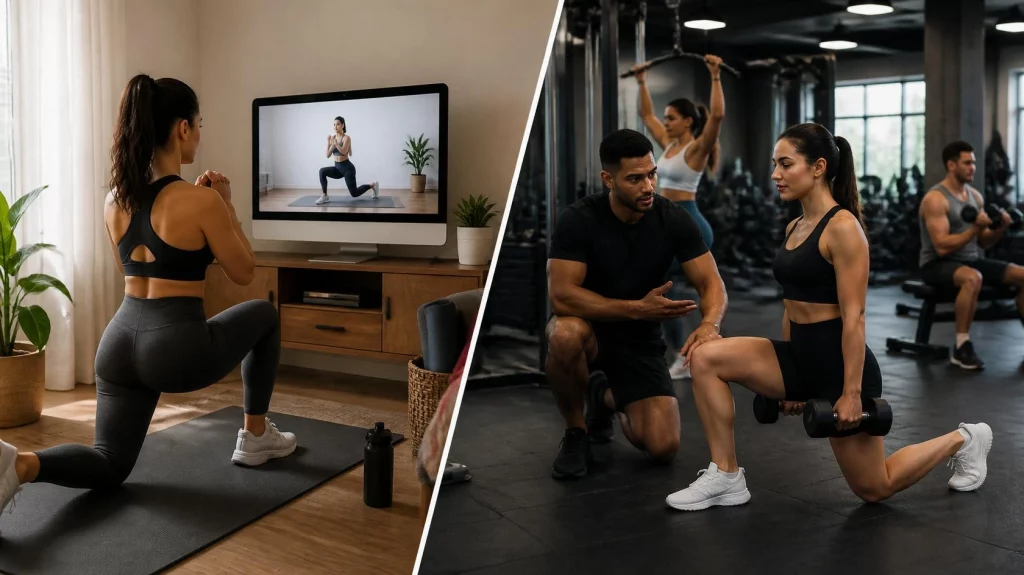
Which Training Style Fits You? Real-Life Scenarios
Choosing between online and in-person training becomes much easier when you look at your actual day-to-day situation instead of comparing features in isolation. Here’s how each option typically fits different types of people.
Online Training Fits You Better If…
Online personal training is often the right choice if your lifestyle or preferences look like this:
- You struggle to stay consistent because of time spent commuting
- Your schedule changes often and you need flexibility
- You prefer training in a private, comfortable environment
- You want to reduce overall training costs without losing coaching support
- You are self-motivated and can follow guidance without physical supervision
- You want regular coaching feedback without being tied to a gym location
In these situations, removing friction from your routine is usually the biggest factor in staying consistent.
In-Person Training Fits You Better If…
In-person coaching tends to work better when you need more structure or direct supervision:
- You are new to training and want to learn proper form from the start
- You feel unsure about exercise technique or injury prevention
- You lose focus easily when training alone
- You perform better when someone is physically present with you
- You want immediate feedback during every movement
- You have access to a gym and prefer using equipment under guidance
Here, the key advantage is real-time correction and external accountability.
Hybrid Training Fits You Better If…
A hybrid approach makes sense if you want flexibility but still value occasional in-person guidance:
- You want to train independently but check in with a coach periodically
- You are returning to exercise after a break or injury
- You want to combine structured programming with occasional hands-on correction
- You prefer adapting your training style depending on your progress phase
This option is often used by people who want long-term flexibility without losing technical support.

Cost Comparison in 2026: How Online and In-Person Training Actually Differ
If you’re comparing in-person training vs online training, cost is probably your first filter. That’s normal. Coaching isn’t cheap. And it shouldn’t be. But the real question isn’t “What does a single session cost?” It’s “What will this cost me over a year?”
Let’s break it down using the current 2026 industry data.
In-Person Training Pricing Structure
Most in-person trainers charge per session, typically billed by the hour. Based on the current 2026 industry data we reviewed, here’s what you can expect to pay:
- Gym-based sessions: US$40 to US$70 per hour on average, with rates reaching US$100 or more in major cities or for specialized trainers
- Home visits: US$100 to US$175 or more per session, since you’re paying for convenience and travel time
❗ Important: Beyond the trainer’s fee, factor in these additional costs:
- Gym membership: US$40 to US$70+ per month, and in some cases over US$100
- Commute: Gas, parking, and travel time add up to a 20-minute drive, which means 40 minutes per session
- Time: A one-hour workout can easily become a two-hour commitment once you factor in travel and waiting for equipment
To help you understand the total cost of in-person training, here are a few common scenarios, factoring in both the trainer’s fees and typical gym membership costs:
| Sessions per Week | Trainer’s Fee (monthly) | Gym Membership (monthly) | Total Monthly Cost |
| 1 session per week | US$55 x 4 = US$220 | US$40–US$70+ | US$260–US$290+ |
| 2 sessions per week | US$55 x 8 = US$440 | US$40–US$70+ | US$480–US$510+ |
| 3 sessions per week | US$55 x 12 = US$660 | US$40–US$70+ | US$700–US$730+ |
| 4 sessions per week | US$55 x 16 = US$880 | US$40–US$70+ | US$920–US$950+ |
| 5 sessions per week | US$55 x 20 = US$1,100 | US$40–US$70+ | US$1,140–US$1,170+ |
Live Online Coaching Prices: How Popular Platforms Compare
Live online coaching is available through several types of services. The table below compares the published starting prices and entry-level offers of five online coaching platforms.
| Service | Starting Price | Entry-Level Offer |
| Happy Trainers | From US$4/session | Live 1-on-1 video coaching |
| Fiverr | From US$5 | Varies by freelancer |
| Superprof | From US$10/hour | Private online lesson |
| Fyt | From US$29/session | Live virtual personal training |
| MyWowFit | From US$25/session | Live online coaching |
These starting prices are not directly comparable in every case. Session length, coach location, specialization, platform fees, and the level of support included can all affect the final cost. A lower starting price does not necessarily indicate lower coaching quality.
At Happy Trainers, you can train live with affordable online personal trainers from around the world, with one-on-one sessions starting from just US$4. Because our coaches are based in different countries, some can offer lower rates that remain fair in their local markets without compromising the quality of their coaching.
Beyond the session price, here’s what online training may add to your costs:
- Internet connection: A stable connection is essential for live video sessions
- Basic equipment: Depending on your program, you may need resistance bands, dumbbells, or a mat, typically costing US$20 to US$100 as a one-time purchase.
These are generally minimal and one-time costs, unlike the recurring costs of gym membership and commute.
Which One Fits Your Budget?
If cost is a deciding factor, it helps to look beyond the price of a single session. Here is what each model can realistically cost per month:
- In-person training: US$260 to US$300+ for just one session per week, before commute, gas, and parking
- Online training: On Happy Trainers, live sessions start from US$4, with no recurring facility or commuting costs.
If budget is not your primary concern and you prefer face-to-face coaching, in-person training can still be a strong choice. But if you want live coaching with more pricing flexibility, Happy Trainers lets you compare affordable online personal trainers, review prices upfront, and choose a certified coach who fits your goals and budget. Some coaches start at lower rates, while premium coaches may charge more based on experience, specialization, and coaching style.

Flexibility and Real-Life Fit
Choosing between in-person and online training isn’t just about the workout itself. It’s about how each model fits with your real life. Let’s compare the key factors to find out which one wins for your lifestyle.
Scheduling Flexibility: Which Option Adapts to Your Busy Schedule?
- In-Person Training: The Fixed Schedule
In-person training requires you to stick to a set schedule. If something unexpected comes up, like work or family obligations, it can be tough to reschedule. Many gyms have strict cancellation policies, and missing a session may still cost you. This lack of flexibility can be frustrating for those with busy or unpredictable schedules. - Online Training: Freedom to Choose Your Time
With online training, you can schedule sessions whenever it’s convenient for you. Whether it’s early in the morning, after work, or on weekends, you control your training times. If something changes, rescheduling is usually easy, and there’s typically no penalty for missed sessions as long as you cancel ahead of time. While this makes online training more adaptable to your life, it also requires a higher level of self-discipline since there’s no in-person accountability.
Travel Time and Effort: Which One Gets You to Your Workout Quicker
Let’s see how each model compares when it comes to getting started:
| Factor | In-Person Training | Online Training |
| Travel Time | Requires commute to the gym (20-60 mins) | No commute required; workout at home |
| Parking/Logistics | Need to find parking, wait for equipment | No parking, no logistics involved |
| Activation Energy | High: Get ready, leave home, drive to the gym | Low: Just open your laptop and start the session |
| Time Spent Outside Workout | Extra time for travel and waiting | No wasted time; straight to your workout |
Conclusion: Online Training is more time-efficient. You skip the commute and the parking hassle, allowing you to start your workout immediately. However, some might miss the motivational environment of a gym, where trainers are physically present to push them.
Gym Anxiety: The Barrier Nobody Talks About
For many people, the real obstacle isn’t scheduling or commuting. It’s the discomfort of training in a public space. Crowded gyms, mirrors, and the feeling of being watched can quietly reduce how often you show up. Online training removes that pressure entirely, letting you train at home with real-time coaching and zero social friction. If this resonates with you, Virtual Personal Training for Gym Anxiety covers the psychological side in more detail.

Safety and Injury Risk
When you think about safety, you might automatically assume in-person training is the safer option. After all, the trainer is right there with you, ready to correct your form. But the reality is that safety isn’t just about whether the trainer’s there in person, it’s about how your training is structured.
- In-Person Training: Hands-On Form Correction
With in-person training, you get the benefit of immediate, hands-on adjustments. Your trainer can correct your stance or technique right away, which is great for beginners. However, just because the trainer is there doesn’t mean injuries won’t happen. If they rush things or don’t manage your load progression properly, you could still get hurt. - Online Training: Real-Time Feedback Through Video
Online training doesn’t give you the chance for hands-on adjustments, but a good coach can still help you out by watching your form during live video sessions. As long as you communicate well and set up the camera properly, they can guide you in real-time. It’s not the same as physical correction, but with the right setup, you can still get solid feedback and avoid mistakes.
Common Injury Triggers in Both Models
Injuries usually arise from behavioral decisions rather than the training format itself. Both models face the same risks:
- Ego Lifting: Lifting weights that are too heavy for your current level, either in the gym or at home. Proper load progression is crucial to avoid this.
- Skipping Warm-ups: Neglecting proper warm-up exercises can cause stress on joints and muscles, increasing injury risk.
- Lack of Communication: If something feels wrong and you don’t speak up, it can lead to injuries. In online training, since the coach can’t physically adjust you, clear communication becomes even more important.
Why Coaching Quality Often Matters More Than Format
Here’s the thing: safety in training comes down to the coach, not the format. A good coach doesn’t just focus on one workout; they think long-term. They’ll:
- Gradually increase weight and intensity to avoid injury
- Keep track of your fatigue and recovery
- Make adjustments based on how you’re doing
If a coach doesn’t know how to manage progression or monitor your form properly, it doesn’t matter if you’re training in-person or online, you’re at risk of injury.
❗ Bottom Line: Safety depends far more on the coach’s approach than on the training format.
Accountability and Motivation Systems
We all know exercise is good for us, but staying motivated and accountable is where most people struggle. The real challenge is showing up, especially on those low-motivation days. Let’s see which model provides better support for accountability.
In-Person Training: Accountability Through Physical Presence
In-person training offers external accountability. Your trainer is right there with you, and if you miss a session, there are often cancellation fees, or you may feel guilty for not showing up. The physical presence of the trainer creates a strong push to keep you consistent.
However, this external pressure can be limiting long-term. Once that structure is removed, you might find it harder to stay motivated.
Online Training: Accountability Through Tracking and Feedback
With online training, accountability is built through tracking and regular check-ins. Your coach can track your progress across multiple sessions, monitor your recovery, and provide feedback on your performance. You can track weights, reps, and even adjust your workouts based on your progress.
This method requires strong self-discipline, but it offers a flexible approach that adapts to your schedule.
Performance and Results: What Actually Determines Success in 2026?
Achieving success isn’t just about where you train. Consistency, intelligent programming, and finding a setup you can maintain are the real drivers of progress. Whether you train in the best gym or follow an online plan, what matters is your ability to stick with the plan long-term.
Beginners and Skill Development
When you’re just starting out, how you learn to move matters more than where you train. Both models can guide beginners effectively, but they do it differently.
| In-Person Training | Online Training | |
| Form Correction | Hands-on, instant adjustments in real time | Visual feedback via live video requires a clear camera setup |
| Progression Structure | Progression often moves faster with full equipment access and real‑time load adjustments | Progression adapts to available equipment and structured programming |
| Best For | Beginners who want physical reassurance and direct guidance | Beginners who prefer flexibility and have a self-aware approach to learning |
Verdict: If you have access and budget, in-person training gives you more immediate reassurance early on. But if that’s not an option, a good online coach with structured programming delivers the same outcome. What actually builds skill is guided repetition, not the format.
Fat Loss and Habit Formation
Fat loss isn’t just about what happens during your workout. Sleep, nutrition, stress, and daily movement drive most of your results. That’s where the two models start to diverge.
In-person training typically covers:
- Scheduled workout sessions
- In-session form and effort guidance
- Some lifestyle advice, depending on the coach
Online training can extend support to:
- Habit tracking between sessions
- Weekly progress check-ins and adjustments
- Nutrition guidance aligned with your training load
- Lifestyle check-ins that go beyond the gym
Verdict: For sustainable fat loss, online coaching has a structural advantage. It’s built to support your daily behaviors, not just your training sessions. Long-term results come from what you do every day, not just the hour you spend working out.
Athletic Performance Goals
If you’re training for strength, speed, or sport-specific performance, the format matters less than you might think. What drives results is programming quality, load management, and recovery tracking, not whether your coach is in the room.
In-person coaching has a clear edge for sports with complex mechanics like Olympic lifting or contact sports, where real-time physical observation makes a difference. For everything else, a well-structured online program with video review and periodization delivers the same results.
Verdict: Evaluate the coach’s expertise and programming depth first. Format is secondary.
Hybrid Training: Is It Right for You?
Hybrid training isn’t a shortcut or a default option. It works for a specific group of people who already have a clear sense of what each model offers them.
You might use in-person sessions for periodic technique refinement while relying on online coaching for day-to-day structure and programming. But this only makes sense if you:
- Want hands-on correction without committing to weekly in-person sessions
- Need flexibility but still value occasional in-person feedback
- Are transitioning between training levels
- Travel frequently or have an unpredictable schedule
If you don’t fit one of these situations, picking one model and sticking with it consistently will get you further than splitting between two.
In-Person Training vs Online Training: Final Decision Table
By now, you’ve seen that this isn’t a simple better-or-worse choice. It’s about alignment with your psychology, schedule, and long-term goals.
Here’s a side-by-side summary to guide your decision:
| Factor | In-Person Training | Online Training (Live Video Coaching) |
| Cost Over 6–12 Months | Higher overall investment | More flexible and often lower total cost |
| Scheduling Flexibility | Fixed appointments | Adjustable sessions and easier rescheduling |
| Travel Required | Yes | No |
| Form Correction | Immediate and hands-on | Real-time verbal correction via video |
| Accountability Style | Physical presence pressure | Digital tracking and ongoing check-ins |
| beginner-friendly? | Best for beginners who feel more confident with in‑person support | Works well for beginners who prefer a guided but independent setup |
| Fat Loss Support | Often session-focused | Broader habit and lifestyle tracking |
| Gym Anxiety | May reduce anxiety with trainer support, but environment remains public | High privacy and psychological safety |
| Personality Fit | Social, externally motivated individuals | Independent, schedule-driven individuals |
| Long-Term Sustainability | Depends on schedule and budget stability | Often easier to maintain consistently |
| Hybrid Option | Can be integrated occasionally | Acts as weekly structure between in-person sessions |
Choosing between in-person vs online training ultimately comes down to alignment with your reality. If you need physical presence and structured appointments, in-person may suit you better. If flexibility, privacy, and time efficiency are priorities, live online coaching may be a better fit.
Impressive setups don’t guarantee results. The right choice is the one you can sustain over time.
Final Thoughts
So, which one wins? There isn’t a universal winner. In-person training vs online training is a decision about what works in your real life.
If you need hands-on guidance, thrive under direct supervision, and prefer structured appointments outside your home, in-person training may feel more natural. If your schedule shifts, you value time efficiency, or you prefer privacy and fewer environmental barriers, live online coaching may be a better fit.
Both models can deliver results. Both can fall short if they don’t match your habits and routine. Professional appearance matters less than sustainability. The key question is simple: Which system can you realistically maintain for the next 6 to 12 months?
Progress is built through repetition over time, not isolated bursts of intensity.
Sources
- Exercise Adherence and Dropout Patterns (2025) — PubMed Central
- How Much to Charge for Online Personal Training — Hevy Coach
- How Much Do Online Personal Trainers Charge? — WOD Guru
- Gym Membership Statistics — Exercise.com
- How Much Does a Personal Trainer Cost? — GoodRx
- How Much Does a Personal Trainer Cost? — MFA Fit
- How Much Does a Personal Trainer Cost? — WOD Guru
